Wednesday, 13 March 2024

Revolution 2020 - Chetan Bhagat

Revolution 2020
Thinking Activity 

Welcome readers! This blog is written as a part of thinking activity assigned by Dr. Dilip Barad sir, from Department of English, MKBU. This blog deals with Chetan Bhagat's fifth novel Revolution 2020 in the paper of Contemporary English Literature. This Novel Published in 2011. As a part of this thinking activity, we are assigned three questions from this novel  and I will give answers of given questions. That questions are given below. 

1. Social realism of corruption in Private education system. 
 
2. Contemporary relevance of Raghav's journalism [The YouTuber / Social media journalism in today's India]

3. Do you think that an opportunity of a good novel is wasted because the story is told from Gopal's perspective? can it be better narrated from Raghav or Aarti's perspective?  How Would it be better if it was narrated from Raghav or Aarti's perspective? 

R{ƎVO⅃}UTION TWENTY20

Chetan Bhagat


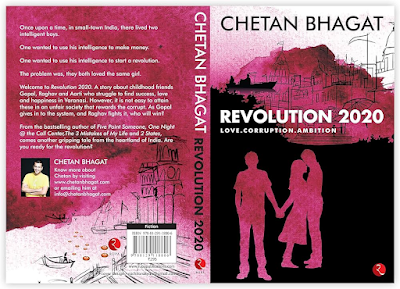
'Revolution 2020 : Love, Corruption, Ambition' is a 2011 novel by chetan Bhagat. Its story is concerned with a love triangle, corruption and a journey of self - discovery. It tells the story of three friends - Gopal, Raghav and Aarti. Gopal, the protagonist of the novel dreams of making something big in life but he finds himself entangled in corrupt practices while trying to achieve his goals. Raghav, his friend is passionate about bringing social changes in the society and fighting against corruption through Journalism. Aarti, the girl they both love, becomes a symbol of their conflicting desires and aspirations. The novel - Revolution 2020 delves into the complexities of relationships and the challenges faced by the youth in contemporary India, ultimately questioning the meaning of success and the pursuit of one's dream in a society plagued by corruption and inequality. 

Chetan Bhagat :- 

 Chetan Bhagat born on 22nd April, 1974 is an Indian Author, columnist, and You tuber. He was listened in Time magazine's list of world's 1000 most influential People in 2010. Five of his novels have been adapted into films. 

Bhagat grew up in a traditional punjabi Hindu family. His father served as a lieutenant in the Indian Army, and his mother worked as a scientist. He claims to have been an average student at 15. His love for writing began during his school years. He used to write articles for the literary magazine of his school and seeing his name printed on the magazine as a writer encouraged him to continue writing. 

He graduated with B.Tech degree in Mechanical Engineering from the Indian Institute of Technology, Delhi in 1995. He also pursued a Master of Business Administration degree in marketing, from the Indian Institute of Management, Ahmedabad ( IIMA) and graduated in 1997. 

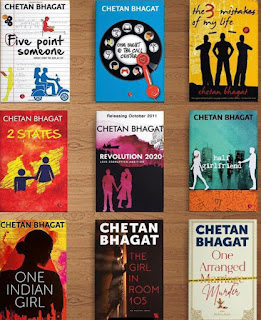
 Chetan Bhagat is the author of thirteen blockbuster books. These include ten novels – Five Point Someone (2004), One Night @ the Call Center (2005), The 3 Mistakes Of My Life (2008) , 2 States (2009), Revolution 2020 (2011), Half Girlfriend (2014), One Indian Girl (2016) The Girl In Room 105 (2018), One Arranged Murder (2020), 400 Days (2021) and three non-fiction titles— What Young India Wants (2012) Making India Awesome(2015) and India Positive (2019). Chetan’s books have remained best sellers since their release. 

Apart from his writing career, He was a celebrity judge on the dance reality show named Nach Baliye , season 7. Apart from that he was also seen in Netflix's series 'Decoupled.' Chetan Bhagat is also a Youtuber. His youtube channel provides motivations to young Indians. He launched a podcast show Deeptalk with chetan Bhagat where he invites accomplished guests for a conversation about how they made it big in life. 

Chetan Bhagat is also very much famous as a motivational speaker. 


His Novels :- 
  • Five points Someone (2004)
  • One Night at The Call Centre (2006) 
  • The 3 Mistakes of my Life (2008) 
  • 2 States (2009) 
  • Revolution 2020 (2011)
  • Half Girlfriend (2014)
  • One Indian Girl (2016)
  • The Girl in Room 105 (2018)
  • One Arranged Murder (2020)
  • 400 Days (2021)

Five of chetan Bhagat's novels have been adapted into films :- 
  • Hello (2008) – Based on the book "One Night at the Call Center"
  • 3 Idiots (2009) – Based on the book "Five Point Someone"
  • Kai Po Che! 
  • 2 States (2014) – Based on the book "2 States"
  • Half Girlfriend (2017) – Based on the book "Half Girlfriend" 

Non - fiction :- 
  •  What Young India Wants (2012)
  •   Making India Awesome ( 2015) 
  • India Positive ( 2019) 
Revolution 2020( R2020) :- 

 “Once upon a time, in small-town India, there lived two intelligent boys.

One wanted to use his intelligence to make money.

One wanted to use his intelligence to start a revolution.

The problem was, they both loved the same girl.”

 R2020 has addressed the issue of how private coaching institutions exploit aspiring engineering students and how parents put their lifetimes earnings on stake for these classes so that their children can crack engineering exams and change the fortune of the family. While a handful accomplish their dreams, others sink into disaster.  The author stated that the novel is based on the "rampant corruption" apparent in the Indian educational system, with the choice of Varanasi as a setting emerging through "a special connection to the city" following his visit. He further said "it is one of our oldest cities, and people there now have modern aspirations. I thought the contrast would be interesting. The city also has a lot of character. 

Author Chetan Bhagat says the idea of his latest work ‘Revolution 2020’ emerged because of the rampant corruption in the education sector which affects millions of youth.

The novel - Revolution 2020 is set in kota and Varanasi. Time - 1996 to 2011. It narrates Gopal's story from 10 year old school kid to 26 year young director of Ganga Tech college. 
 

1. Social realism of Corruption in the Private education system. 

Answer :- Chetan Bhagat in his novel, mostly chosen the themes which are happening in the contemporary society,  particular Indian society. They includes modern education system in India, Indian corrupt political system, problem of students, parents attitude towards their wards, Students’ longing for coaching classes, etc. His novel mostly deals with the life and problems of youngsters. Here he stresses on corruption in the educational field. Revolution 2020 is a critical novel on corruption in Indian education system and coaching classes for competitive exams in India. 

Gopal - represents lower Middle class family. 
 Raghav - represents Middle class family. 
Aarti - represents Upper class family. 

Thus, this core group of characters presents a Metro city from the filthy rich to the marginalized poor. Corruption is one of the major theme of this novel.  The life of students at Kota is very hard. They spend a lot of hours on study. The realistic theme of students’ life is given here. Bhagat writes about a day in the life of aspiring students in Kota : 

 'I could call myself a true Kota ite a month into moving there. Like thousands of other students, my life now had a rhythm. Career Path resembled a school, but without the fun bits. Nobody made noise in class, played pranks on one another or thought of bunking classes. After all, everyone had come here by choice and had paid a big price to be here …'

'Lectures started at two in afternoon and went on until nine in evening. After that students rushed home to eat dinner, and do the ‘daily practice sheets’, a set of ten problems based on the current lesson … I went along with madness, not so much because of the zeal to prepare, but more because I wanted to keep myself busy. I didn’t want Kota’s loneliness to kill me.' 

  The novel is an ambitious with a bunch of characters and themes, set in Indian city. The story moves from Varanasi to Kota and again to Varanasi. Moving from place to place, Bhagat’s characters keep floating in the novel and do not stick to one incident. They keep achieving their goals, trying to link up plot of the novel but too little avail. Bhagat has tried to reveal the mind of his characters. The author in the novel has given minute details of corruption in Indian politics, administrative, and educational system. Corruption has burrowed Indian political, social, and educational system. Talking about corruption Chetan Bhagat says ; 

 'In India, one question is constant: why isn’t corruption going away? The question baffles the educated middle classes. Why is a reasonable, universal and noble demand for an honest society so difficult to achieve in a democracy? And why is it that corrupt parties win election time and time again.'

 MLA shukla is a political leader and most corrupt man of Varanasi. He was the only one who helped Gopal in finding private institution and also taught him that how to pay people.  On the other side, Raghav is the protagonist and Journalist who fights against corruption and wants India as the corruption free country. Corruption not only made hole in Indian political system but has also spread in educational system. 

Indian parents are extra careful about the future of their children. Gopal’s father wants his son to be an engineer from India’s top most colleges. His father is a retired teacher and involved in a court case against his elder brother. Gopal in his first attempt for AIEEE fails to score the required marks. After getting known Gopal’s low score his father does not talk properly with him. Gopal tells his father that he wants to do B.Sc. His father cannot control his anger and says ; 

 Gopal, “who gives a good job to a simple graduate? ''

   Parents and teacher who without seeing their son’s ability send him to Kota. Prateek tells Gopal.

“Most of us can’t crack these tests, basic probability. But who will drill it into our parents’ head?”

 Raghav’s father is not interested in NIT and tells his son to do engineering from IIT. The hopes of Indian parents are bigger than their children. Chetan Bhagat makes Raghav’s character as one of the most idealistic characters among his all the characters as he has put his own views through this character. Raghav in the novel plays the role of an activist who wants to bring change in Indian society by eradicating the corruption. He for the sake of society declines his job offer of and joins as a reporter at newspaper agency. His inner desire does not keep him quiet so he starts his own newspaper, Revolution 2020. 


'kota now had small coaching shops to coach you to get into the top coaching classes. from there, you would be coached to get into an engineering college.'

 The novel criticizes how private coaching classes for courses such as IIT, JEE exploit aspiring students. Indian parents put their hope and desires on relying these private coaching classes that is why their children can crack tests and they bring change the fortune of their middle class family. The novel - Revolution 2020 explores the reality of the private coaching industry which thrives on corruption and scams. Ambitions or aspirations of youth is the important theme that the novelist handled in this present novel. 

 Raghav aspires for his desire that he wants to be social reformer. His aspirations to change the world through social reformation and movement. He wants to see the society as a corruption free society. He thinks that his article on Ganga cleaning scam brings somewhat changes in the political system. In the very beginning of the novel Aarti and Gopal love to each other but in the middle of the story, she was attracted towards Raghav who has cracked IIT JEE exam in his first attempt. But he does not want to do engineering. He wants to be journalist. Raghav said that  'Journalism is my passion.'  Raghav attempts to change the world through his first article published in newspaper ; 

 What do you say about a society whose top leaders are the biggest crook? What do you do in a system where almost anyone with power is corrupt? India has suffered enough. From childhood we are told India is a poor country. Why? There are countries in this world where an average person makes more than fifty times that an average Indian makes. Fifty times? Are their people really fifty times more capable than us? Does an Indian farmer not work hard? Does an Indian student not study? do we not want to do well? Why, why are we then doomed to be poor?

Raghav wants to change in Indian society. He thinks that one day his articles would bring change in Indian political system, in private coaching institutions as well as in private colleges. Many private colleges’ owners have no degree in the respective fields but they opened colleges and earned large amount from their institutions. So, he decides to work as a journalist to remove corruption from the society.  Chetan Bhagat elaborates the social evils, political issues, corruption and problems of youth generation through this present novel. The novel mainly focused on love, corruption and ambition. He illustrated the theme of love with different attitudes and shades. 

To Conclude, Chetan Bhagat's novel Revolution 2020 focused on the theme of social issues, realism and it also highlights on social evils and unfair practices. It deals with the aspirations of youth, the problem of unemployability, youth struggled for their ambitions and the scenario of the private coaching institutions. 

 2. Contemporary relevance of Raghav's Journalism. [ The Youtuber / Social media Journalism in today's India]. 

Answer :-   “Revolution 2020” is an attempt to highlight the corruption rooted in India’s education system and bring out the anomaly of education. The fiery activism of Raghav who wants to bring about a change in society through journalism, despite having graduated as an engineer. He says that ; 

  “This has to stop. We have to clean the system. Che Guevara, the great revolutionary, once said, ‘Power is not an apple that falls from a tree into your lap. Power had to be snatched from people who already have it.’ We have to start a revolution, a revolution that resets our corrupt system. A system ,that shifts power back into the hands of the people and treats politicians like workers, not kings.”

 Raghav, who gets admission to IIT, turns to be a sort of idealist. Even though he gets a job, he turns to journalism as the way to clean up the society. He gets a partial success, but has financially drained. He can only circulate his publication “Revolution 2020” less than 500 copies. Yet he can bring out the secret deals of Shukla and succeeds in sending him to jail. That affects the future of Gopal as his business deals are also closely connected with the politician. But Gopal realizes that Raghav’s path is right and sacrifices his love for Aarti and makes her turn away from him. She finally selects Raghav. The narrative is unbalanced because it is being narrated by Gopal, so all the characters that grace this novel are told as what they mean to Gopal. But Raghav ends the story still hoping for a bright corruption free nation.  Raghav’s strength is that he is very intelligent, sincere and also ambitious. It is through him Chetan Bhagat tries to convey his message. 

Life is not all about making and working just for the sake of earning money. One has to follow his dreams; this is the message brought out through Raghav.

 Raghav is the most inspiring character in “Revolution 2020”. Though Raghav had good academic profile and is selected in many colleges he gave up all those offers just to become a journalist and through his writings he decides to root out the evils from his corrupted city or nation as a whole. He is ready to bring a revolution against everything corrupt and wrong happening in the society. He strongly believes that someone has to stand up against the system to reform the society.  The character of Raghav wants to expose the corrupt education system, the profit making private education sectors and issues of bribes, etc. 

 “Revolution 2020. That’s his goal. That India must have a full-blown revolution by 2020. Power will be the youth. We will dismantle the old corrupt system and put a new one in place.”


Independent Journalists :- 

1. Karan Thapar :- 

Karan Thapar is an Indian Journalist, news presenter and interviewer working with The Wire.  Known for his aggressive interviews with leading figures, Karan Thapar has navigated through various media houses since 1981. His unyielding questioning even made waves during an interview with the current Prime Minister, Narendra Modi, showcasing the impact of fearless journalism. 


2. Ravish Kumar :- 

Ravish Kumar is an Indian Journalist, author and media personality. He was the senior Executive Editor of NDTV India.  Ravish Kumar stands as a beacon of true journalism, reporting on the ground realities and issues faced by ordinary Indians. His sharp insights and integrity have earned him the prestigious Ramon Magsaysay Award, and his term ‘Godi Media’ has become a household term for media channels driven by political and corporate interests. 


3.  Punya Prasun Bajpai :- 
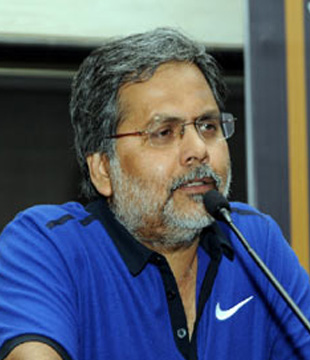
Punya Prasun Bajpai is an Indian Journalist. He has worked at several news networks in his career. An accomplished journalist and writer, Punya Prasun Bajpai’s in-depth knowledge of Indian politics is evident in his body of work. Notable for his program ‘Masterstroke,’ Bajpai left ABP News due to perceived government pressure, showcasing his commitment to unbiased reporting. 

Punya Prasun Bajpai on You tube


4. Abhisar Sharma :-  

Abhisar Sharma is an Indian Journalist, Television news Anchor and Author.  A seasoned journalist and anchor with a career spanning from 1995 to 2018 in mainstream media, Abhisar Sharma has since transitioned to freelance journalism. His outspoken and emotional approach to reporting, notably in instances like discussing the tragic death of a small Muslim child, reflects a deep concern for the country’s well-being. 

5. Devanshi Joshi :- 

Devanshi Joshi is a Gujarati Journalist who is containing the spirit of independent media. she is also a senior producer of the company. Moreover, she runs a news- based youtube channel.


Devanshi Joshi is a news anchor who worked in Nirmala News and Sandesh (Gujarathi news company). She is also a senior producer of the company. Moreover, she runs a news-based YouTube channel.
6. Rajdeep Sardesai :- 

Rajdeep Sardesai is an Indian News Anchor, reporter, Journalist and Author. 


7. Shyam Meera Singh :- 
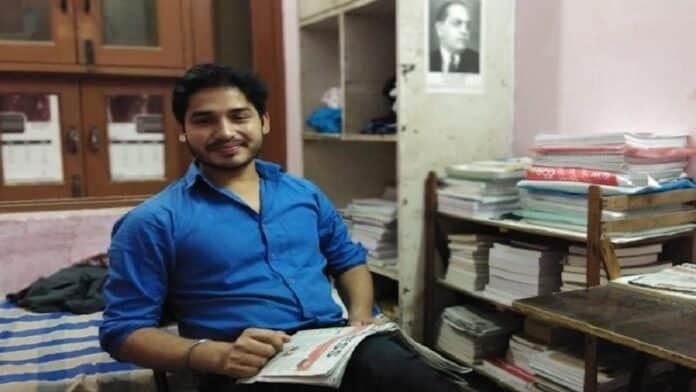
Shyam Meera Singh is an Indian Journalist and Youtuber. He was working with Aaj Tak, but was fired from Aaj Tak because he did tweet critical to PM Narendra Modi. 

He was awarded with connecting alumnae of the year from Indian institute of Mass communication. He also started his own Youtube channel in May 2022. 

8. Dhruv Rathee :- 

Dhruv Rathee is an Indian Youtuber, Vlogger and social media activist. He is known for his Youtube videos on social, political, and environmental issues.
He introduced the satirical "fake news" segment Pee News and, in 2020, initiated the Dhruv Rathee Vlogs channel for international travel vlogs.


Question 3 :- Do you think that an Opportunity of a good novel is wasted because the story is told from Gopal's perspective? Can it be better if narrated from Raghav or Aarti's perspective? How would it be better if it was narrated from Raghav or Aarti's perspective? 

Answer :-  Chetan Bhagat's novel - Revolution 2020 is told from the perspective of Gopal. He himself is the narrator of the story. Chetan Bhagat - Author of the novel is present as a character. Gopal belongs to poor family and his father was a Farmer. Gopal is a character who faces various challenges and moral dilemmas throughout the plot. By doing corruption Gopal becomes the director of Ganga Tech college. When we read the story from Gopal's perspective and point of view,  the narrative may lack depth and seriousness as R2020 comes under the classification of popular literature and it lacks high seriousness and sincerity. 

Raghav Kashyap is an idealistic character who is passionate about bringing change in society. He belongs to upper class family and cracked JEE exam in first attempt. But, followed his passion and becomes journalist as he wants to bring change and reformation in the society. If the story is told from Raghav's perspective, as a reader we might get a deeper insight into his motivations, struggles and societal issues. 

Looking at the story through Aarti's perspective could given us a different view of the love triangle. Her character, even though important in the love story. Seeing things from her side could shown us more about her feelings, thoughts and the tough choices she has to make between two men who want her. But, In my views Narrating the story from Aarti's Perspective, readers can only know about her love relations rather than anything else. But, Three of these characters from Chetan Bhagat's novel Revolution 2020 Played very important role. 

 Gopal's Perspective - Corruption 
 Aarti's Perspective - Love 
 Raghav's Perspective - To Bring Revolution

  Through these characters we can understand that they are connected with each other and presented the core concern of the novel in their own unique and different way. 

Conclusion :-  To Conclude,  Revolution 2020 is a thought provoking novel that explores the deep - seated corruption and lack of opportunities in India's education system and society at large. Through the stories of its main characters, Gopal, Raghav and Aarti, Chetan Bhagat highlights the struggles faced by the youth in pursuing their dreams and aspirations. 

 While the characters Journeys are fictional, the underlying issues addressed in the book resonate with the harsh realities faced by many young Indians.'Revolution 2020' is a compelling novel that leaves the reader with a sense of hope for a better future, if corrective measures are taken to the existing system.  


Thank you for Visiting...😊

Monday, 11 March 2024

Thinking Activity - The Ministry of Utmost Happiness

Thinking Activity 

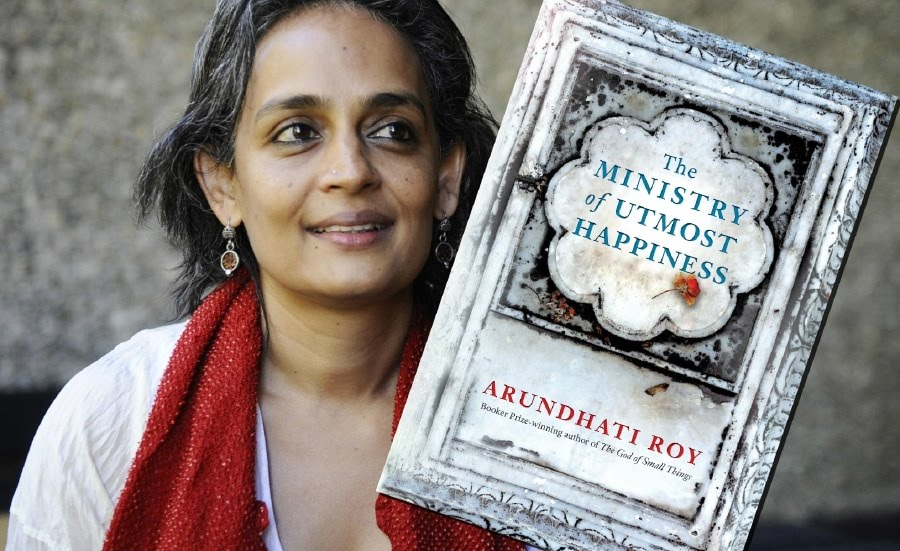
Welcome readers! This blog is written in response to the thinking activity assigned by Dr. Dilip Barad sir from Department of English, MKBU. As a Part of that, I will try to answer the questions assigned by sir from Arundhati Roy's novel 'The Ministry of Utmost Happiness.' That questions are ; 

1.   What is the symbolic significance of Vulture and Gui Kyom (Dung Beetle) in the novel? 

2.  How is the intertextual references to other writers in the novel connected with the central theme of the novel? [also mention the epigraphs in English & Hindi]. 

3.  Instead of privileging the center stage,  'The Ministry of the Utmost Happiness' shifts the spotlight to the back alleys and hidden corners, granting agency to those typically relegated to the sidelines. Analyze how Roy's decision to center the periphery enriches our understanding of social, political, and existential realities often ignored by mainstream narratives. 


Question 1 :- What is the symbolic significance of Vulture and Gui Kyom ( Dung Beetle) in the novel? 

Answer :- In Arundhati Roy's novel 'The Ministry of Utmost Happiness' , Roy uses a references of Vultures and Gui Kyom to show us new ways of looking at the world. They represents deeper ideas and  messages. Roy wants us to think differently about the world around us. she wants us to see things we might not normally notice and understand deeper truths about society and people. so, when we read about the references of Vultures and Gui Kyom in the novel, The Ministry of Utmost Happiness, we are not only reading but rather it is about exploring bigger ideas and questions about life and society. 

 By incorporating the references of Vultures and Gui Kyom ( Dung Beetle), Arundhati Roy challenges readers to confront uncomfortable truths and to expand their understanding of the world around them. We can say that Roy employs Vulture and Gui Kyom as vehicles for her message, inviting readers to explore realms of thought and experience that are often overlooked in traditional literature. 


The novel is crammed with animals. Smelly old dog, Biroo; the fertile bitch, Comrade Laali and her litters; Payal, the scrawny white mare; two delightful kittens, Khanum and Agha and the rooster, Sultan, all play important roles. Finally, Guih Kyom, the dung beetle, introduced only on the last page, ‘lying on his back with his legs in the air to save the world in case the heavens fell’.   Ruling the roost, so to speak, are the vultures in the prologue. In the 1990s cattle were given Diclofenac to increase their milk production and when they died the white-backed scavengers or, waste removers, ingested the cow meat.   The drug caused the ‘vultures’ necks to droop’ resulting in them ‘tumbling off their branches, dead’. Ethnic cleansing. Vulture genocide. 


 Arundhati  Roy uses creatures to symbolise various aspects of Indian life, especially political ones. The dung beetle, characterised as unclean, untouchable, is able to drag 1,141 times its body weight of faecal matter. But is it possible that Guih Kyom is also a symbol for hope, a cleanser of the vast, chaotic, filthy, rancid democracy that is India?

It’s hard to decide whether The Ministry of Utmost Happiness is magic realism. In the first chapter, ‘Where do old birds go to die?’, it is unclear whether Anjum, one of the central characters, is still alive or whether she is now a tree. She has branches and leaves and can feel the ghostly talons of vultures but also sleeps on a carpet ‘between two graves at night’. There are also the preternaturally tall bulls. I think that Roy takes her characters to the edge of sanity, into a place where the Duniya, or real world, thins out into a transparent layer in which the laws of physics don’t quite work.

1. Vulture :-   Arundhati Roy has penned her concern regarding innumberal issues that called for public attention. She emphatically asserts that the creatures and characters that populate her novel are not magical. All the images that appear are neither magical not metaphorical but true. The attention then moves to the latter half of the prologue. The unstained appetite of human has led to the extinction of the white backed vultures and sparrows. The vultures are natural scavengers and feed on dead flesh. However, as the prologue tells the vultures have died of diclofenac intoxication.  The veterinary administration of diclofenac as a muscle relaxant in cows and buffaloes to enhance dairy production has led to the large scale death of white - ramped vultures. 

 The vultures populated Indian forests and helped in the process of sanitation by consuming the cases of dead animals.  The vultures' death in the story shows a bigger idea about how nationalism can be harmful. It's like a warning about what happens when we focus too much on one national identity and ignore the value of different cultures. The author, Roy, uses this symbol to talk about her worries about how nationalism can limit people's freedom to think and create, and how it can erase the diversity that makes cultures unique. It's a strong way to start the book, making us think about the problems that come with blindly following one idea or story. 

2. Gui Kyom ( Dung Beetle) :-   


The novel ends with the image of Gui Kyom, the graveyard's resident dung beetle lying on his back with legs in the air to save the world in case the heavens fall. The dung beetle feeds partly or exclusively on fasces and the posture of the beetle as described here is a tell - tale sign of a dead or dying insect. Gui Kyom is dead or dying but also wide awake and on duty, like a dung - eating, six -legged version of the Titan Atlas; filled with hope and conviction, the beetle thinks to himself, things will turn out all right in the end. They will, because they have to. 

 Thus the dead, the dirty, the abhorred become the lively conditions for hope and flourishing in the novel. The Symbol of Gui Kyom linked with Anjum. So, that is how this novel - The Ministry of Utmost Happiness ends hopefully as Udaya Jebeen - second is seen as the hope for everyone. Gui Kyom, the Dung beetle reflects hope for the earth's preservation. 


Question 2 :-  How is the intertextual references to other writers in the novel connected with the central theme of the novel? [also mention the epigraphs in English & Hindi]. 

Answer :- Arundhati Roy's novel 'The Ministry of utmost Happiness' , the use of epigraphs that provide the '' external skeleton'' of the structure, as it were. The novel is divided into twelve chapters of varying lengths, unevenly distributed into six sections, each introduced by  a short epigraph. The six quoted authors were all poets or writers who held strong, dissident political views, who rebelled against persecution, who refused submission and compromise. Tormented by institutional violence , censored, imprisoned, some were killed. Others were discriminated against for their skin color, and / or their sexual orientation and gender 'indeterminacy'.  All were resolutely insubordinate. 

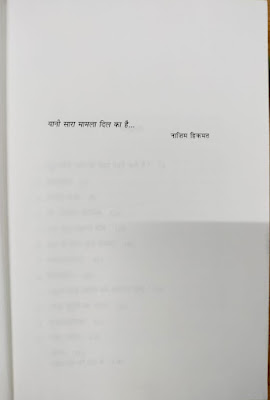
1. "I mean , it's all a matter of your heart.'' - Nazim Hikmet
 [ यानी सारा मामला दिल का है... नाज़िम हिकमत]

The first epigraph (“I mean, it’s all a matter of your heart”) was taken from Nâzim
Hikmet’s poem “On the Matter of Romeo and Juliet”. Read in the context of Hikmet’s poem, it finds an echo in Roy’s playful paragraph about the links between
Romeo and Juliet  and the Arabo-Persian story of Laila and Majnun  in which she circuitously introduces the first of her two heroines by differing the mention of her name and personal history. 

Anjum plays with words, gliding from Anjuman to mehfil (from administrative gathering to artistic recital), insisting on the refusal of exclusion and discrimination: “Everyone’s invited”. In Anjum’s cemetery, those who are most welcome are those who are shunned and rebuked everywhere else. Cemeteries in India are ghettoized spaces ungraciously conceded to the minorities, to the Muslims and Christians who bury their dead instead of cremating them. Ironically, Anjum’s cemetery, open to the unwanted, becomes a symbol of the diverse, inclusive, secular nation that India used to claim to be. 

2. " In what language does the rain fall/ on tormented cities? - Pablo Neruda 
     [बारिश किस भाषा में गिरती है/ यातनाग्रस्त शहरों  के ऊपर ? - पाब्लो नेरुदा]  

The second epigraph Arundhati Roy quoted Pablo Neruda, another exiled poet. 
Roy chose to quote from Neruda’s last book, Libro de las Preguntas (The Book of Questions), published posthumously in 1974. It is considered a children’s book, but many of the questions asked, whether they be poetic, philosophical, whimsical, or humorous, can be as intriguing and profound as any in the Book of Job. There are a number of ''tormented cities'' in the India depicted by Arundhati Roy, and her constant attention to, and interest in, the sheer number and variety of Indian languages are also echoed here. 

The very first page can be read on one level as a humorous ecological fable about the dangers of “progress” and the collateral damage of globalization and American style consumerism, but the vultures are also given tragic dignity as the lost “custodians of the dead.''  with whose ghosts Anjum “confer[s]” The vultures, killed by the very carcasses they were supposed to pick and clean, provide a metaphor of the paradoxical treatment of Untouchable cow skinners at the hands of Hindu lynch mobs. 

3. Death flies in, thin bureaucrat, from the plains'', a fit frame for the third ''section''. - Agha Shahid Ali 

    [मौत एक छरहरी नौकरशाह है, मैदानों से उड़कर आती हुई - आग़ा शाहिद अली]

The third epigraph quotes the first line of one of Agha Shahid Ali’s Kashmiri poems, “Death flies in, thin bureaucrat, from the plains”, a fit frame for the third
State. “section”, narrated by “The Landlord”, a cold and somewhat cynical servant of the

Agha Shahid Ali left Kashmir for the USA as a young man, but suffered, from afar,
all the anguish and sorrow of the devastation visited on his homeland. His poems, and especially the collection Roy quotes from, entitled The Country Without a Post Office, have been a source of inspiration and solace for many a Kashmiri, and Ali certainly is present as a tutelary voice in the books the Kashmiris have written since his death in 2001, either explicitly, in quotations and epigraphs, or implicitly, as in Roy’s novel, when she describes mourners at a funeral fleeing from shooting soldiers, leaving behind the dead and wounded: “And shoes. Thousands of shoes”.

4. Then, as she had already died four or five times, the apartment had remained available for a drama more serious than her own death. - Jean Genet

["क्योंकि वह पहले चार या पाँच बार मर चुकी थी, अपार्टमेंट उसकी मृत्यु से भी ज़्यादा गंभीर किसी नाटक के लिए उपलब्ध था। - ज्याँ जेने"]

The fourth epigraph is by Jean Genet, whose novel Notre-Dame-des-Fleurs (written while its author was serving a prison sentence in Fresnes, in 1942) is quoted three times in The Ministry of Utmost Happiness. Many links do exist between the two literary universes. The events of Genet’s life, and his books, give him a place of choice among the “Unconsoled” and the “Indeterminate”, and the paradoxical co-existence of the languages of eroticism and religion in Notre-Dame-des-Fleurs.

The narrative originality of Genet’s novel, the constant slipperiness and fluidity of literary genres and of points of view, the constant efforts to find new narrative techniques that rebel against classifications, and defy rounded, conclusive interpretations, cannot but have inspired Roy, who was attempting to create the same kind of effects, and striving to eschew simplification and achieve complexity. In The Ministry of Utmost Happiness, comedy, political satire, elegy, tragedy, poetry, realism, magic realism, parody, all happily co-habit. Points of view shift and vary.

5. And they would not believe me precisely because they would know that what I said was true. - James Baldwin.

["और वे मेरी बात पर सिर्फ़ इस वजह से यक़ीन नहीं करते थे की वे जानते थे कि मैंने जो कुछ कहा था वह सच था। - जेम्स बाल्डविन"]

The fifth epigraph is quoted from James Baldwin’s essay entitled “Down at the cross. Letter from a Region in my Mind”, which offers a set of reflections on race relations in the USA. Read in the light of caste relations in India, many of those reflections also seem perfectly relevant. She denounces similar denials in India, regretting that even for left-leaning intellectuals and prominent scholars, “caste is at best a topic, a subheading, quite often just a footnote”, adding bitterly that such attitudes sometimes come “from a place of such rarefied privilege that caste has not been stumbled upon, not even in the dark, and therefore it is presumed to have been eradicated, like smallpox”.

Roy chose to quote Baldwin and not, for instance, Martin Luther King, who was very much influenced by Gandhi’s example; but she is no fan of Gandhi’s. Arundhati Roy highlights that that casteism and racism are “indeed comparable” as both scorn and target other people because of their ancestry, their birth and blood, their alleged tainting impurity. It connects the mere act of riding a horse is considered an honor to which Dalits must not aspire. A young Dalit who was beaten to death because he dared to ride a horse in Gujarat.

6. Then there was the changing of the seasons. 'This is also a Journey,' M said, 'and they can't take it away from us.' - Nadezhda Mandelstam

["फिर मौसमों में परिवर्तन हुआ। 'यह भी एक यात्रा है,' एम ने कहा, 'और इसे वे हमसे छीन नहीं सकते।' - नादेज्दा मान्देल्स्ताम"]

 The final epigraph used by Roy is a quotation from Nadezhda Mandelstam’s first
volume of memoirs, Hope Against Hope, in which Osip Mandelstam’s widow narrates his
tragic fate. Nadezhda Mandelstam played a crucial role for Osip’s literary legacy as she
was the one who memorised his unpublished poems and then smuggled them out of the
USSR for publication.  It is easy to see how the descriptions, in this memoir, of human suffering under oppression could find instant comprehension and sympathy with Roy; the reader recalls her cold rage and bitter graveyard humour when suggesting the extremities of
torture in the Shiraz cinema, and when depicting the martyred bodies of shattered youths, like the “broken bird” who refused to show pain. 

And yet Arundhati Roy retains the idea of “hope against hope”, hope in the face of impossible odds. 


Question 3 :-  Instead of privileging the center stage,  'The Ministry of the Utmost Happiness' shifts the spotlight to the back alleys and hidden corners, granting agency to those typically relegated to the sidelines. Analyze how Roy's decision to center the periphery enriches our understanding of social, political, and existential realities often ignored by mainstream narratives. 

Answer :-  Arundhati Roy's book - The Ministry of Utmost Happiness does something different from typical stories. Instead of focusing on the main characters in the spotlight, it pays attention to the people usually pushed to the sidelines- those in the back alleys and hidden corners of society. By doing these, Roy gives these characters a voice and importance. This shifts helps us to see a different perspective on social, political and existential issues that are often overlooked in mainstream stories. Arundhati Roy shifting the spotlight to the periphery, and enriches our understanding of society and humanity by giving voice to those who are often silenced and overlooked. 

Depiction of Social execution in 'The Ministry of Utmost Happiness' :- 
 
 Arundhati Roy that primarily deals with the socio-political issues of modern Indian society. The narrative features everybody and is about everybody who has been neglected, suppressed, and socially excluded by the powerful classes. The novel mainly features the transgender community, women, children, tribal population, Kashmiris, Dalits, etc. and talks about how they face multiple forms of suppression and oppression and how they have been socially, politically, geographically, and economically excluded. Roy becomes their savior and gives them a space to make their demonstrations and demands heard and addressed. She has tried to create an environment for these disadvantaged people. 

1. Anjum :-  Transgender people are classified as a third gender and termed neither men nor women. They have been facing social exclusion and alienation and also identity crises for a long time because they can't define themselves in conventional male or female terms. They are dismissed by their families as well as by society. They are marginalized everywhere and are forced to live the life of an “other”. They are restricted both in education and in public spaces, and because of certain limitations, they choose to live a life of seclusion. They are oppressed people, and as a result, face legal, social, and economic challenges. They don't have good access to education, health care, or public spaces. These people do not fit into society's standards because they have been deprived of their social rights. They still have an identity crisis in this stereotypical culture which is centered on the stereotypical relationship between men and women. They are unable to accommodate themselves, and their families to are turned away by society. They are deprived of psychological, physical, and political freedom almost everywhere. The issue of gender discrimination in The Ministry of Utmost Happiness is depicted by Roy through the character of Anjum, who is born as Aftab, but soon is discovered to have Hijra tendencies, and after many surgeries become Anjum, leaves her home and begins to live with the Hijra community in the Khwabgah (house of dreams). 

After discovering that her child (Anjum) was not a normal boy, Anjum’s mother even tried to hide it from her husband. The child’s sexual identity shocks and terrifies the mother. She began reacting quite differently and became very disappointed as they had been impatiently waiting for the son to be born, but to her surprise, it was not a ‘normal’ baby. She wasn’t able to make her eyes and heart believe what has happened to her. “There, in the abyss, spinning through the darkness, everything she had been sure of until then, every single thing, from the smallest to the biggest, ceased to make sense to her.

At home too Aftab was hated and excluded just because he was born like this. He began to attend music classes and there faced the burnt of teasing and mocking by his mates once they discovered a little difference in him and them. 

“He’s a She. He’s not a He or a She. He’s a He and a She. She-He, He-She Hee! Hee! Hee!” 

He possessed a body that blurred the lines between male and female. The tale of Aftab highlights the difficulties of living in a culture dominated by essentialist gender explanations. Aftab, a woman trapped in a man's body, accepts his/her female identity in the hopes of realizing his/her true self.

According to Judith Butler, 
                                                      ''People need not regard gender to be passively determined but “it is a process of constructing ourselves”

2. Dalits :-  Another major character Saddam Hussain who is born Dayachand, and becomes Anjum’s first guest at Jannat Guest House. He is born into a low- caste, Dalit family, but after his father is mercilessly murdered by an unruly mob for being suspected of killing a cow, converts to Islam. He faces alienation and exclusion in society on the base of his caste. A social structure like this doesn’t allow him to have his voice heard freely and fairly. He can be termed as the representation of a subaltern in the novel. 

3. Musa Yeswi :-  Another major character of the novel is Musa Yeswi, a Kashmiri, who turns to militancy after his wife, Arifa, and his daughter, Miss Jabeen, are killed by the security forces. He is the representation of the Kashmiris being put to the margins and being silenced and forced to leave their homes and the life of peace to become rebels. Musa then goes underground and dies there for the cause of Kashmir. He is the representation of the subaltern Kashmiris.

4. S. Tillotama ( Tillo) :-  Another socially oppressed character in the name of Tillotama, called Tilo, who some readers believe is the representation of Roy herself. The life story of Tilo is told in narrative form. Roy emphasises the internal struggles of transgender persons in Anjum's narrative and paints a picture of an environment filled with turmoil in Tilo's life. Through Tilo's life, the miserable existence of the Kashmiri people is intricately portrayed. Her search for Kashmiri activist Musa gets her into trouble.

She has witnessed the brutal treatment of citizens by military officers. They shave her head to interview her when she survives it. It's a comment on how the government implements and justifies its gender-based policies. She vows to never let her hair grow long again in an effort to get back at him. Her existence in the world of fiction challenges some assumptions about the roles that men and women play in the public and private spheres. As she broke free from the constraints of family life and transitioned from the private to the public sector as an activist, her social and political identity began to take shape. 

5. Kashmiri Conflict :- Arundhati Roy's novel "The Ministry of Utmost Happiness" delves into the complex Kashmir conflict through various characters and narratives. In the novel, Kashmir isn't just a physical location but a symbol of conflict, loss, and longing. Through the experiences of characters like Tilo, Musa, and others, Roy explores the human toll of the conflict, depicting the struggles, aspirations, and traumas faced by Kashmiris. She portrays the brutality of military occupation, the emotional turmoil of families torn apart, and the resilience of individuals amidst ongoing violence and political instability. Through her vivid storytelling, Roy brings attention to the Kashmir conflict, urging readers to confront the realities. 

Conclusion :-  To Conclude, Arundhati Roy's novel 'The Ministry of Utmost Happiness' it can be said that the novel depicts the voices of the subaltern people and depicts people who are socially and politically excluded by the powerful classes, upper castes, the state forces of the modern society. Arundhati Roy on one hand narrates the stories of the victims of social exclusion and on another provides them space to express their say independently. She again looks to be very much concerned about ‘The Unconsoled’ as she had been previously in her other writings and also in her talks.

Thank you for Visiting...

Assignment Paper No. 210(A)

  ● Name :- Hetal Pathak ● Roll No. :- 09  ● Semester :- 4 [ Batch 2022- 2024]  ● Enrollment No. :- 4069206420220022 ● Paper No. :- 210(A) ●...